Down with the Clothing Mess!
De Klerenpartij (The Clothing Party) advocates against power of fast fashion and in favour of a fairer and more sustainable clothing system.
In the Netherlands alone, we buy 1 billion garments every year and produce 12 kilos of textile waste per person. We believe clothing is not merely an economic product, but a social, ecological, and cultural phenomenon. Clothing as a reflection of a healthy economy and a healthy society. That is why we are putting clothing on the political agenda!
Manifesto of De Klerenpartij
From fashion-conscious to conscious Fashion
Clothing makes us feel beautiful. It makes us feel good and comfortable. Clothing expresses our identity. But clothing also has an ugly side. A side that leaves us feeling uneasy and uncomfortable. Because the fashion industry runs on pollution, exploitation, and addiction. Or more accurately: it is an industry structurally dependent on overproduction, low wages, and consumerism.
De Klerenpartij stands up for the victims of fashion.
For the people in distant countries who make our clothes for starvation wages. For everyone addicted to cheap (ultra) fast fashion and overpriced designer brands. For the people, animals, forests, seas, and rivers suffering under one of the most polluting industries in the world.
For sustainable fashion entrepreneurs and recyclers. Those struggling with the dominance of large retail chains, online marketplaces, and the enormous supply of cheap synthetic textiles from China. But also, for people whose wardrobes remain 80% unworn. For households with limited budgets that can barely afford clothing. And for everyone who, like us, believes fashion is about more than appearances and deserves a place on the political agenda.
Clothing connects us to one another, to the world, and to the people who make our clothes. Everyone who does not walk through life completely naked deals with clothing every day. So: if we change clothing, we can change the world!
What we stand for
- We stand for clothing that does justice to people and planet.
- For craftsmanship instead of mass production.
- For connection instead of waste.
- For an economy based on care, not sweat.
De Klerenpartij aligns itself with the EU Textile Strategy (2022), which aims for circular, sustainable, and fair textile chains in Europe, as well as national ambitions for fair wages and sustainable production. But we want more: we want clothing to have a place on the political agenda.
What we want
- Stop the temptation: Ban fast fashion advertising, starting with outdoor advertising.
- Polluter pays: High import tariffs on cheap synthetic textiles and a ban on the export of textile waste .
- Local clothing production: Structural support for entrepreneurs and community initiatives across the entire local circular chain: farmers, designers, sewing ateliers, repair services, and recycling companies.
- Education in craftsmanship: Every child learns sewing, knitting, and repairing – because those who can make something buy less and throw away less.
- Fair price, fair chain: Clothing made with living wages, certified materials, and transparent supply chains; brands must pay for collection, repair, and recycling.
How it started
De Klerenpartij emerged from a storylab titled Reshaping The Fashion Narrative (ReFan), organised by AMFI and creative network Changency in June 2025. More than 45 pioneers from the fashion and textile chain participated in the workshop: researchers, designers, producers, influencers, repairers, and recyclers. The aim of the workshop was to question the current fashion system and create desirable future visions.
De Klerenpartij was one of eight future scenarios developed during the sessions.
Storylab designer Dagan Cohen (Changency) and designer Billie van Katwijk, who came up with the name ‘De Klerenpartij’, both recognised the potential of the concept and decided to join forces to bring the party to life.
Launch
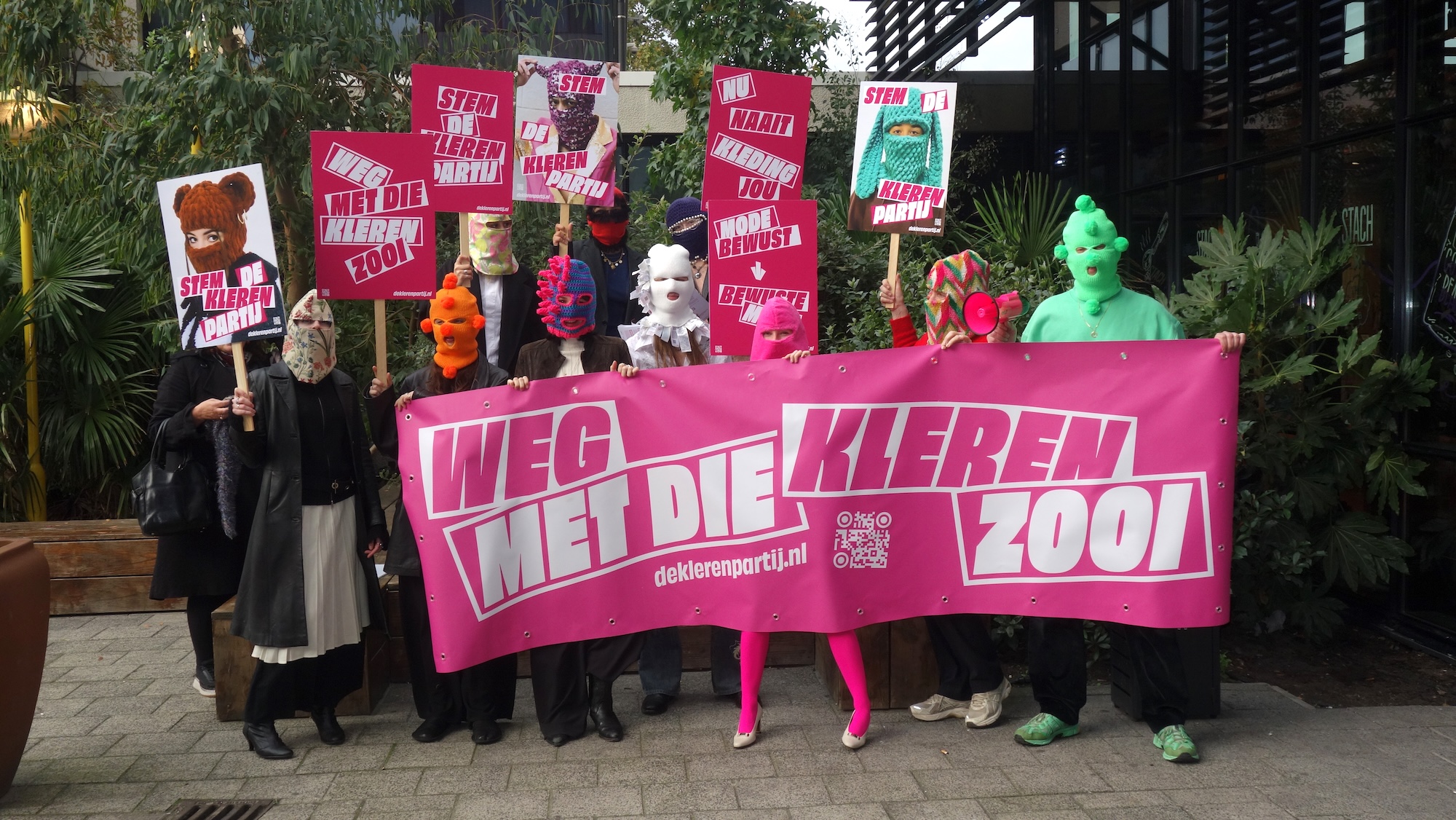
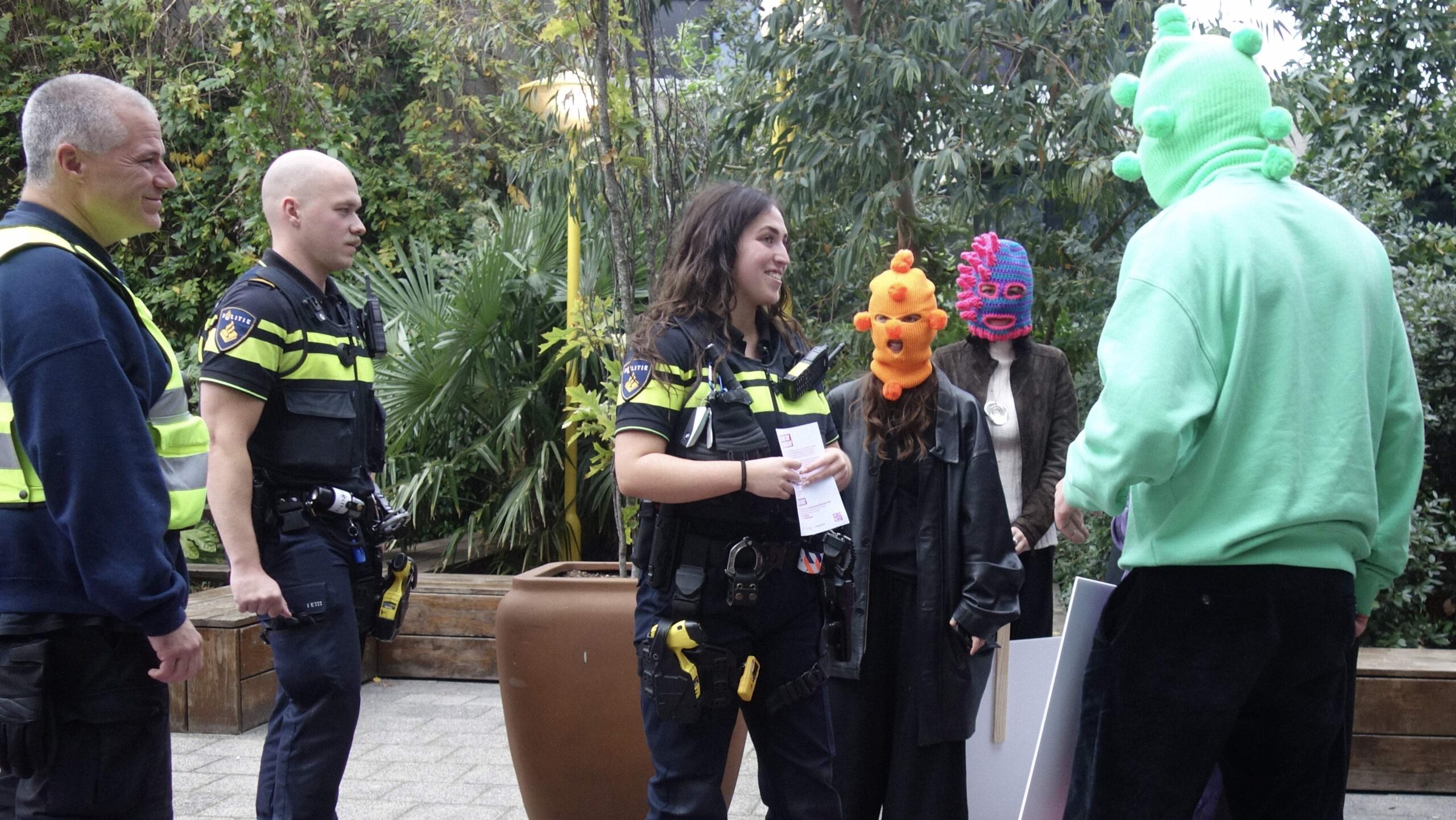
De Klerenpartij was ‘launched’ through a striking protest performance in October 2025 at the Society 5.0 festival in Amsterdam. Students and teachers from AMFI participated under the leadership of founders Dagan and Billie. Within a short period of time, a visual identity and manifesto were developed, alongside a website, flyers, posters, and banners. Although De Klerenpartij had been invited by the festival organisation, the performance was perceived as so disruptive by venue staff that the police were called and the group nearly got arrested.
What’s Next?
The Clothing Party at the State of Fashion Biennale 2026
During State of Fashion on May 29 in the council chamber of Arnhem, De Klerenpartij will submit a few motions in favour of a fairer and more sustainable clothing system.
These motions are developed in close collaboration with more than twenty leading pioneers in the fashion and textile sector. The motion-letters will be presented to the council and public speakers. In summary, the motions are as follows:
Motion 1: Encourage clothing awareness and making skills
Teach primary school students practical basic skills such as sewing, knitting, and crocheting.
Introduce secondary school students to the full textile chain through site visits – from farmer, design studio, weaving mill and sewing atelier, to distribution centre, retailer, repairer, sorting facility and recycling company.
Increase the visibility of sustainable clothing alternatives in the city, such as second-hand clothing stores, clothing swap events, repair and maker spaces, and useful digital apps. In doing so, help residents make more conscious and sustainable clothing choices.
Motion 2: Strengthen the local infrastructure for circular entrepreneurs and community initiatives
- Provide affordable space for entrepreneurs and initiatives across all essential parts needed for a local, (bio)circular clothing and textile chain – from land for organic raw material production and material labs to design studios, clothing shops, repair hubs, sorting facilities, and recycling spaces.
- Develop subsidy instruments, acceleration and growth programmes that support the professionalisation and long-term viability of circular businesses and initiatives.
- Ensure a level playing field for sustainable entrepreneurs through access to visible A-locations in the city and subsidised public outdoor advertising.
Motion 3: Put circular textile policy into practice within the municipality’s own organisation
- Purchase only locally made, (bio)circular workwear and interior textiles, and collaborate with local repairers for maintenance and repair.
- Bring the circular textile transition to life within city hall and other municipal locations through clothing swap events, repair corners, sustainable clothing helpdesks, presentations, and workshops by local sustainable entrepreneurs and community initiatives.
- Use training and professional development budgets for civil servants to strengthen knowledge and skills around circular textiles through company visits across the textile chain and courses in sewing, knitting, and crocheting (just like school students).
Leading by example
By adopting these motions, Arnhem – as the ‘fashion capital of the Netherlands’ – can not only position itself internationally as a frontrunner, but also serve as an example for other Dutch municipalities in addressing circular challenges. Above all, it can demonstrate how sustainable and locally made alternatives can be made visible and accessible to all residents.
Join the Clothing Party
De Klerenpartij is a public initiative by designers Billie van Katwijk and Dagan Cohen in collaboration with the Amsterdam Fashion Institute (AMFI), ArtEZ, and the Research Community New Tex Eco. The party sees itself as a ‘creative crowbar’ for cultural change around clothing – from a throwaway culture to a culture of making.
The central question posed by the party is: How can we continue to dress beautifully without being trapped in a system built on the exploitation of people and the planet? How do we break the endless cycle of overproduction and overconsumption?
Focus
In the coming period, De Klerenpartij will focus primarily on the role of municipalities in accelerating the circular clothing and textile transition: from education and awareness to strengthening the local ecosystem of entrepreneurs and community initiatives.
At present, De Klerenpartij does not yet have a formal legal status. Establishing an association seems the logical next step. In the meantime, everyone fighting for a fair and sustainable fashion and textile chain – or simply caring for their clothes as lovingly as for a pet – is warmly welcome to join De Klerenpartij.
Want to think and make along with us?
Send an email to: info@deklerenpartij.nl
And follow our socials!